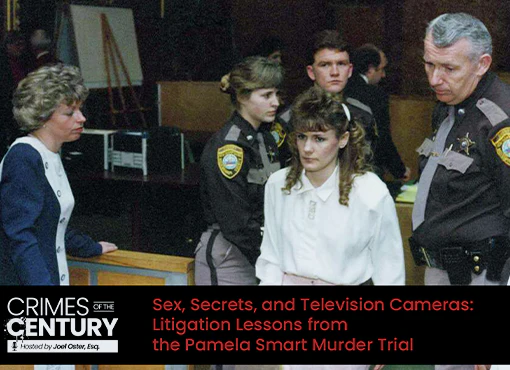
Crimes of the Century CLE: Sex, Secrets, and Television Cameras: Litigation Lessons from the Pamela Smart Murder Trial
Crimes of the Century CLE: Sex, Secrets, and Television Cameras: Litigation Lessons from the Pamela Smart Murder Trial
In 1990, 24-year-old Gregg Smart was found shot to death in what initially appeared to be a botched burglary at the New Hampshire condominium he shared with his wife, Pamela Smart. As investigators dug deeper, they uncovered a sensational story involving an affair between Smart, a high school media coordinator, and a teenage student. Prosecutors alleged that Smart manipulated her teenage lover and his friends into murdering her husband so she could avoid a divorce and pursue the relationship. The case ultimately resulted in a conviction for conspiracy, accomplice liability, and witness tampering.
The trial became one of the first criminal cases in America to receive extensive gavel-to-gavel television coverage, transforming a local murder prosecution into a national media spectacle. Prosecutors relied heavily on cooperating witnesses, secretly recorded conversations, and circumstantial evidence to portray Smart as the mastermind behind the crime. The defense argued that the teenage perpetrators acted on their own and falsely implicated her to secure favorable plea deals.
This class examines the Pamela Smart prosecution as a case study in accomplice liability, witness credibility, plea-bargained testimony, media influence, and trial strategy. Participants will explore how prosecutors built a compelling narrative without direct evidence that Smart ordered the murder and how defense counsel attempted to counter a case fueled by publicity, emotion, and cooperating witnesses. The lessons remain highly relevant for litigators handling high-profile cases today. Register today!
This program is designed in conjunction with attorney Joel Oster, Comedian of Law and True Crime Podcaster.
Original: $99.00
-65%$99.00
$34.65Crimes of the Century CLE: Sex, Secrets, and Television Cameras: Litigation Lessons from the Pamela Smart Murder Trial
In 1990, 24-year-old Gregg Smart was found shot to death in what initially appeared to be a botched burglary at the New Hampshire condominium he shared with his wife, Pamela Smart. As investigators dug deeper, they uncovered a sensational story involving an affair between Smart, a high school media coordinator, and a teenage student. Prosecutors alleged that Smart manipulated her teenage lover and his friends into murdering her husband so she could avoid a divorce and pursue the relationship. The case ultimately resulted in a conviction for conspiracy, accomplice liability, and witness tampering.
The trial became one of the first criminal cases in America to receive extensive gavel-to-gavel television coverage, transforming a local murder prosecution into a national media spectacle. Prosecutors relied heavily on cooperating witnesses, secretly recorded conversations, and circumstantial evidence to portray Smart as the mastermind behind the crime. The defense argued that the teenage perpetrators acted on their own and falsely implicated her to secure favorable plea deals.
This class examines the Pamela Smart prosecution as a case study in accomplice liability, witness credibility, plea-bargained testimony, media influence, and trial strategy. Participants will explore how prosecutors built a compelling narrative without direct evidence that Smart ordered the murder and how defense counsel attempted to counter a case fueled by publicity, emotion, and cooperating witnesses. The lessons remain highly relevant for litigators handling high-profile cases today. Register today!
This program is designed in conjunction with attorney Joel Oster, Comedian of Law and True Crime Podcaster.
Product Information
Product Information
Shipping & Returns
Shipping & Returns
Description
In 1990, 24-year-old Gregg Smart was found shot to death in what initially appeared to be a botched burglary at the New Hampshire condominium he shared with his wife, Pamela Smart. As investigators dug deeper, they uncovered a sensational story involving an affair between Smart, a high school media coordinator, and a teenage student. Prosecutors alleged that Smart manipulated her teenage lover and his friends into murdering her husband so she could avoid a divorce and pursue the relationship. The case ultimately resulted in a conviction for conspiracy, accomplice liability, and witness tampering.
The trial became one of the first criminal cases in America to receive extensive gavel-to-gavel television coverage, transforming a local murder prosecution into a national media spectacle. Prosecutors relied heavily on cooperating witnesses, secretly recorded conversations, and circumstantial evidence to portray Smart as the mastermind behind the crime. The defense argued that the teenage perpetrators acted on their own and falsely implicated her to secure favorable plea deals.
This class examines the Pamela Smart prosecution as a case study in accomplice liability, witness credibility, plea-bargained testimony, media influence, and trial strategy. Participants will explore how prosecutors built a compelling narrative without direct evidence that Smart ordered the murder and how defense counsel attempted to counter a case fueled by publicity, emotion, and cooperating witnesses. The lessons remain highly relevant for litigators handling high-profile cases today. Register today!
This program is designed in conjunction with attorney Joel Oster, Comedian of Law and True Crime Podcaster.